Just read some interesting news in an article written by one of my favorite science journalist, Karin Boys, in the Swedish newspaper Dagens Nyheter:
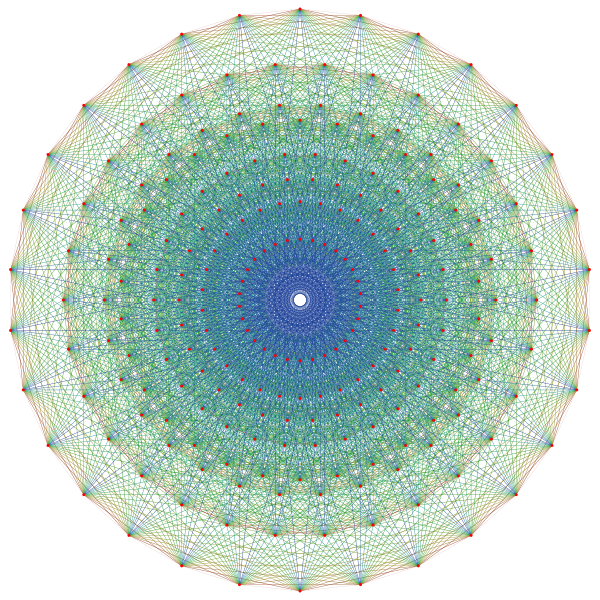
they have found the physical existence of the magically beautiful E8-pattern – displayed in the image here below – one of the most complex mathematical concepts in the world which took weeks for a hall of super-computers to calculate and resulted in 400 000 printed pages. Researchers have been hoping that E8 is connected to the search for the great Theory of Unification, which shall bring together Einstein’s general theory of relativity and quantum mechanics (which is not possible with todays maths). And now symmetries from this pattern was discovered by a group of German and English physicists when they froze cobalt nitrate to the absolute 0-point, which made the electrons arrange themselves in kind of rows or chains. Then they exposed this to magnetic fields, and in the magnetic fluctuations which evolved the strikingly beautiful E8 pattern was spotted.
by Claudio Rocchini (wikipedia)
I mean, if it came down to looks I’d so far wote for this pattern to be the door to open the true Unification theory, it is just really amazing, isn’t it?!
This is not the first time mathematicians has calculated something which physicists did not yet know of, or they even considered impossible. The last time such a discovery was made was in 1974 by Sir Roger Penrose, who I actually made an 1 hour long interview with in the Vienna Riesenrad back in 2004. He calculated something called quasicrystals, a pattern of two shapes which can repeat endlessly without repeating a pattern. This was considered completely impossible, but was later found, for example in a type of stone in Siberia, and has even shown to have quite some practical use to it.
Just found this great, simple, to the point summary of the connection between Quantum Science and the basic ideas of classic Asian philosophy and religion like Buddhism, Taoism and Hinduism, made by Gerald Penilla
One can of course make many arguments against drawing the sort of conclusions which Gerald present in this film. The most common one argument that I have heard is that mathematics are only abstractions and that they just cannot say anything about reality as it really is. Which brings at least my mind to the question if one can say anything about reality as it is…
No matter what point of view you have, I think that you will find the connections which Gerald presents here at least interesting.
I think that the most striking about the conclusions presented above is that we are very likely co- creating not only ourselves, but also each other and our reality with our thoughts and attitudes, in a not only spiritual but also physical sense.
A very good reason to love ourselves, one another and our surroundings: to love all of existence.
And with loving I do not mean some illusion-based infatuation which is denying the difficult, challenging or “bad” sides of reality, each other, existence;
no, I mean a deep, true feeling of compassion, which results in compassion, and love, streaming out of the body, mind and soul, influencing oneself and the surroundings to do good and feel well. And love.
I have read a lot since ever since I started to read, and about twelve years ago I started to read literally enormous amounts of esoteric and Holy literature, all from the Tao and the Bible to The Celestine Prophesies, Conversations with God, books on Wicca, Tantra, symbolism, Celtic traditions, astrology and all books of Carlos Castaneda. At the same time I was studying philosophy in History of Ideas and Science class at the University, then Sociology and practical and theoretical Film Science. Upon that I started intense studies in shamanism and healing, as well as tantra meditation.
In the end this all became to much, and I started focusing on working (after the Uni), trying to make my way in the so called “real” world. I admit this was not always successful, but I have had my ups too, and since 3-4 years all is well and getting better. Anyway, I gave up reading every book that caught my attention, but somehow after I while, I still wanted to take in more information. So I continued researching about the world, but now through large amounts of films, all kinds of news channels and documentaries, often found browsing. I also developed a great interest for theoretical physics.
I did continue to read books of course, but much much less, and very few on spiritual development – I had had an overload… Some Rudolf Steiner and Castaneda, an occasional shamanic book or article which I got from the teacher I had back then.
But most of all, I continued reading this one book on spiritual development which I started reading 10 years ago, over and over again – and it never stops enlightening me. And I kept hearing/dancing/mediating/doing healing to this one particular CD. Now I have started to reach out for new information and music, and also to spread more information, films and other things to others.
Still both this CD and this book will always be with me: created by true masters – high quality support on a chakra journey:
JOURNEY INTO CONSCIOUSNESS the Chakras, Tantra and Jungian Psychology
Discipline is standing with her small pet dragon on her arm. She looks like a strict teacher as she seems to pass her training thoughts to the baby dragon.
I think that the image also tells the tale the other way around: the baby dragon is transferring its wisdom to the fairy as well. Looking at the branch one cannot tell if she is holding up the branch for the dragon, or the other way around? I believe that they are leaning on the same branch – a branch of the gathered knowledge of all Eternity- which they are both constantly contributing to. Considering the myth of the enlightened mind of a loving dragon, the following question also rises – who has the “most” wisdom? Is there such a thing? And does it matter?
I think the amount of wisdom does not matter, and that every being have their unique wisdom and discipline – basically: their own way. This image reminded me of that, and that wisdom is not restricted to knowledge, sex, race, kind or level of existence – all beings have their unique wisdom, and all beings can reach the top of expressing that wisdom, partly through discipline.
All beings always have something to teach us at all time, since all beings actually express the highest form of what they have been capable of developing under the circumstances which we all live in. And no matter how lost someone seem, she or he or it might give you that one piece of information that you need at this very moment to form your own discipline.
This is what makes the grand masters I think: that they know that they are always as much a student as a master
It is good to remember that the Goddess Disciplina was an important but minor Goddess, pointing to that you can have several varieties of her – several disciplines in your life. But maybe it also says that you should not exaggerate the amount of different disciplines in your life, nor take discipline too seriously, or better said, not to obsess about this Goddess. Sometimes learning a discipline takes you on unexpected paths, where you have to let go of discipline(s) in many life areas for the time it takes you to transform and evolve. It can be difficult for the confused mind to know how to impose discipline to get further on the best or at least the desired way:
sometimes I think the best is to just wish for healing and go with the flow, which this is also a form of discipline…
In the end, discipline plays a very important part in reaching fulfillment: if you want to express yourself in this dimension, it is indispensable to have it.
Latin word disciplina was especially used to refer to military training, but could also mean “education”, “ordered way of life”, or refer to the results of training; and it was also used in the modern sense of “body of knowledge” or “science”, such as is applied to a philosophical or scientific study or system.
In Roman mythology, Disciplina was a minor deity and the personification of discipline.[1] The word disciplina itself, a Latin noun, is multi-faceted in meaning; it refers to education and training, self-control and determination, knowledge in a field of study, and an orderly way of life.
Her chief virtues were frugalitas, severitas and fidelis—frugality, sternness, and faithfulness. In worshiping Disciplina, a soldier became frugal in every way: with money, with energy and actions. The virtue of severitas was shown in his focused, determined, not easily dissuaded, and decisive behavior. He was faithful to his unit, his army, the officers and the Roman people.